Alernov Pest Control ServicesAlernov Pest Control Services

Subterranean Termite Treatment & Baiting

Dayton sits along the Great Miami River basin, where dense alluvial clay loam soils retain sustained subsurface moisture throughout spring thaw and summer humidity. These damp soil profiles create prime nesting…
Call (937) 637-0033 →(937) 637-0033
Subterranean Termite Treatment & Baiting in Dayton, OH
Quick answer
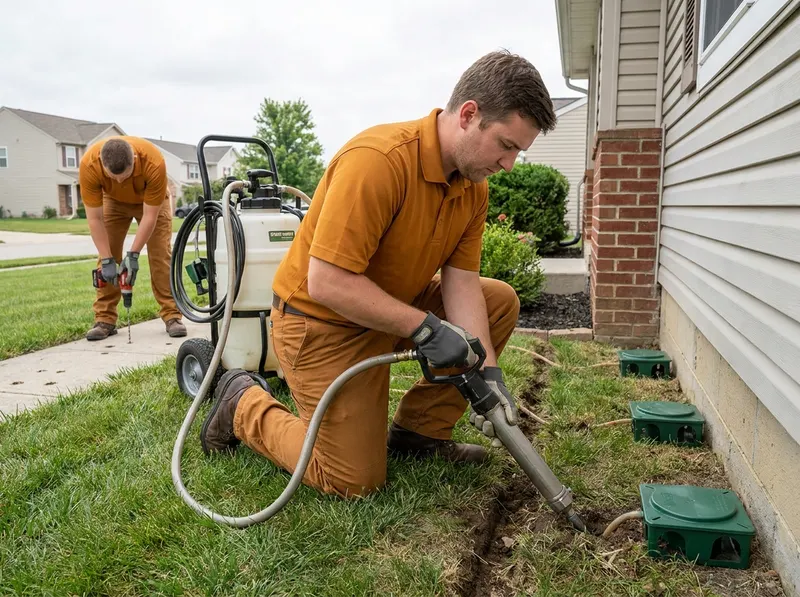
  • What is included: Complete structural foundation inspection, exterior perimeter soil trenching or in-ground bait station grid placement, and targeted colony elimination monitoring.
  • Response speed: On-site structural inspections scheduled within 24 to 48 hours, with treatment systems installed during a single service visit.
  • Service cost: Termite defense services range from a $250 minimum for localized spot treatments to $2,400 for comprehensive whole-structure liquid barriers and bait systems, with exact pricing confirmed during the on-site inspection.
  • Target pests: Eastern subterranean termites (Reticulitermes flavipes), subterranean swarmers, and active mud tubes ascending foundation walls.
  • How to schedule: Call (937) 637-0033 to book an on-site structural termite assessment across Montgomery County.

Dayton sits along the Great Miami River basin, where dense alluvial clay loam soils retain sustained subsurface moisture throughout spring thaw and summer humidity. These damp soil profiles create prime nesting environments for *Reticulitermes flavipes* (Eastern subterranean termites). In historic neighborhoods like the Oregon District, South Park, and Dayton View Historic District, older wood framing often interfaces directly with porous limestone, soft brick, or rubblestone foundations. Subterranean termites construct narrow shelter tubes across foundation mortar joints to bypass masonry barriers and access sill plates, band joists, and subflooring completely shielded from plain view.

Selecting between non-repellent liquid soil barriers and in-ground baiting systems depends on foundation construction and site hydrology. A continuous liquid perimeter trench creates an undetectable subterranean zone around block, poured concrete, or slab foundations common in Belmont, Walnut Hills, and Shroyer Park, neutralizing foraging workers as they pass through the treated zone. For properties with complex interior slab designs, finished basements, hydronic radiant floor heating, or sensitive water tables near RiverScape MetroPark, exterior bait stations provide high-potency cellulose matrices infused with insect growth regulators that workers distribute back to the central subterranean queen.

Protective termite control prioritizes structural preservation over fear-based recurring chemical applications. Surface spraying wood inside living quarters fails because the reproductive engine remains insulated 4 to 10 feet beneath the frost line. Deploying calibrated liquid treatments around structural footings or spacing tamper-resistant bait stations every 10 to 15 feet creates verifiable perimeter defense, protecting high-risk structural zones without intrusive structural alterations.

What it costs

Localized Subterranean Spot & Entry Point Treatment$250 – $550
Exterior In-Ground Bait Station System Installation$850 – $1,600
Full Perimeter Liquid Soil Barrier (Trench & Rod Treatment)$1,200 – $2,400
Annual Termite Warranty Inspection & System Re-Arming$250 – $395

Every job gets a firm, written price after a free on-site visit.

Common questions

How can I tell if my Dayton home has subterranean termites or winged ants?
Subterranean termite swarmers feature straight antennae, uniform thick waists, and two pairs of equal-length translucent wings that shed rapidly, whereas winged carpenter ants have elbowed antennae, pinched waists, and unequal wing sizes. The presence of dried earthen mud tubes along foundation walls in Dayton properties confirms subterranean termite activity.
Are termite bait stations effective against active structural infestations in Dayton?
Termite bait stations effectively eliminate subterranean termite colonies by introducing a slow-acting chitin synthesis inhibitor that worker termites transport back to the nest. For severe active structural feeding inside a Dayton home, combining bait matrices with localized non-repellent liquid applications halts active wood consumption faster.
How deep into Montgomery County soil are liquid termite barriers applied?
Liquid termiticides are trenched and injected down to the top of the foundation footing, typically 4 to 6 inches deep adjacent to exterior walls or down to 4 feet along basement walls. This creates a continuous treated soil envelope around the Dayton structure.
Will subterranean termite treatments harm historic masonry in South Park or the Oregon District?
Modern liquid soil treatments and exterior bait stations do not degrade historic lime mortar, fieldstone, or soft clay brick. Exterior trenching introduces products directly into the perimeter soil without requiring invasive drilling through decorative exterior stone.
How often should termite bait stations be monitored in Dayton, OH?
Termite bait stations in Dayton are routinely evaluated annually or semi-annually depending on surrounding subterranean pressure and station bait consumption. Stations that show termite feeding are replenished with fresh active matrix to maintain continuous colony suppression.

Ready to get started?

Tell us about your subterranean termite treatment & baiting job in Dayton and we'll send a clear, written quote — usually the same day.